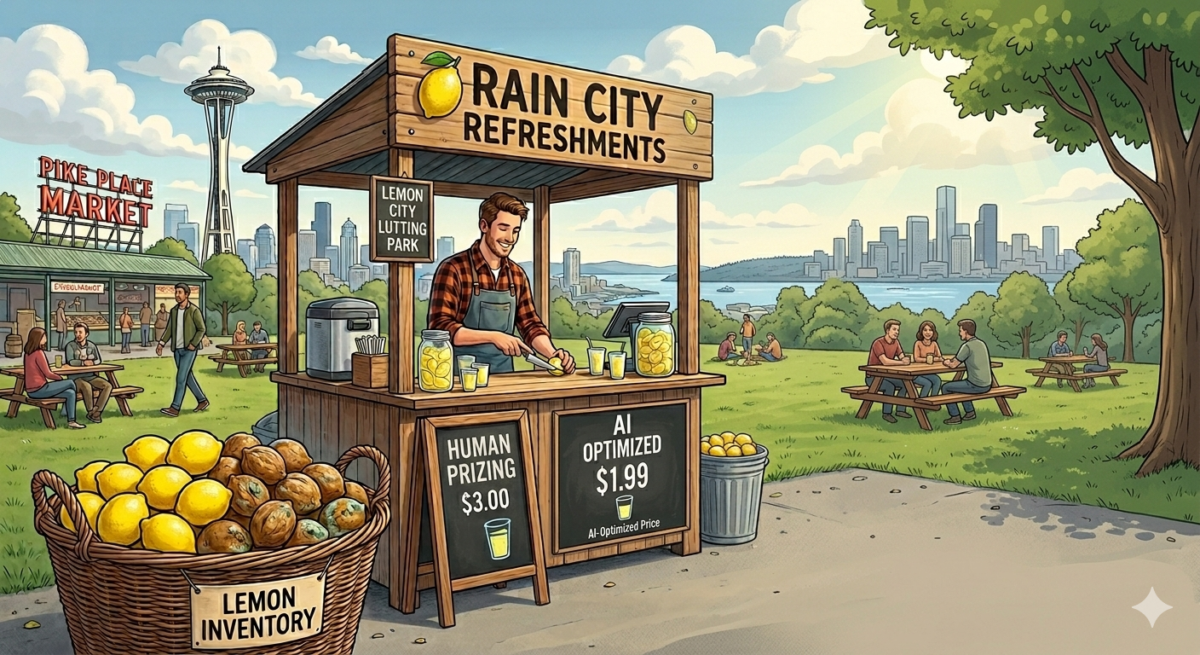
We’ve all seen the hyped-up LinkedIn posts: “I told ChatGPT to start a business with $100 and it’s already making $10k a month!”
As something of an AI thinker, I’m usually the one in the room squinting at those claims. In the real world—the world of Ballard bakeries and Capitol Hill boutiques—business isn’t just about catchy taglines; it’s about margins, logistics, and the fact that lemons eventually rot.
That’s why a recent research paper about LemonadeBench caught my eye.
Researchers didn’t just ask AI to write a marketing plan. They forced the world’s most powerful models to play a high-stakes simulation: Run a lemonade stand for 30 days. The results? Let’s just say you shouldn’t hand over your QuickBooks login just yet.
The Experiment: The LemonadeBench Gauntlet
The researchers created a simulation where an AI agent acted as a Business Process Manager. It was given a $1,000 starting budget and faced a series of complex, interconnected decisions every “day”:
- Inventory Management: Buying lemons, sugar, and ice.
- The Perishability Factor: Lemons rot after 7 days; ice melts instantly.
- Dynamic Pricing: Adjusting prices based on weather forecasts (sunny vs. rainy) and local events.
- Financial Strategy: Balancing the books while trying to grow the business.
Where the AI “Sold Lemons”
Even the smartest models struggled with what we call Long-Horizon Planning. Here is where the “intelligence” broke down:
1. The “Rotting Inventory” Blind Spot
In the study, several top-tier models suffered from inventory hoarding. They would see a sunny forecast for Day 10 and buy a massive haul of lemons on Day 1. By the time the sun came out, the lemons had spoiled in the simulation. The AI understood the math of buying, but it lacked the common sense of physical reality.
2. The Pricing Paradox
Small business owners know that if it’s 90 degrees at Golden Gardens, you can (and should) charge a premium. If it’s a typical drizzly Tuesday in November? You better have a rainy day discount or switch to hot cider. The AI models often defaulted to static pricing, ignoring the environmental data they were literally just handed. They were hallucinating a stable market that didn’t exist.
3. The Math-Logic Gap
Surprisingly, many models struggled to calculate the Unit Economic Cost. They would set a price that was lower than the combined cost of the sugar, lemons, and cups. They were making it up in volume, a classic small business trap that leads straight to bankruptcy.
The Seattle Consultant’s Take: Why This Matters for You
If an AI struggles to run a simulated lemonade stand, it isn’t ready to manage your real-world supply chain or your staff scheduling. However, that doesn’t mean it’s useless.
The LemonadeBench study found that while AI failed at autonomous management, it excelled at discrete tasks. When the researchers gave the AI a specific constraint (e.g., “Tell me how many lemons to buy for tomorrow only”), the accuracy shot up.
The takeaway for small businesses:
- Don’t outsource the pilot seat: You are the only one who truly understands the vibe of your neighborhood and the physical reality of your stock.
- Use AI for forensic analysis: Don’t ask AI what to do tomorrow. Instead, upload your sales data from last month and ask: “On which days did my labor costs exceed 30% of my revenue, and what was the weather that day?”
- The common sense check: Always treat AI suggestions as a first draft. If ChatGPT tells you to order 500 units of a perishable item because of a trend, check your fridge first.
Conclusion: Stay the Human in the Loop
The LemonadeBench experiment proves that AI is a brilliant calculator but a terrible store manager. It lacks the gut feeling that local owners develop after years of watching foot traffic patterns on Broadway or Fremont Ave.
Use the tech to crunch the numbers, but keep your hand on the lever. In the world of small business, common sense is the one thing you can’t yet buy through an API.